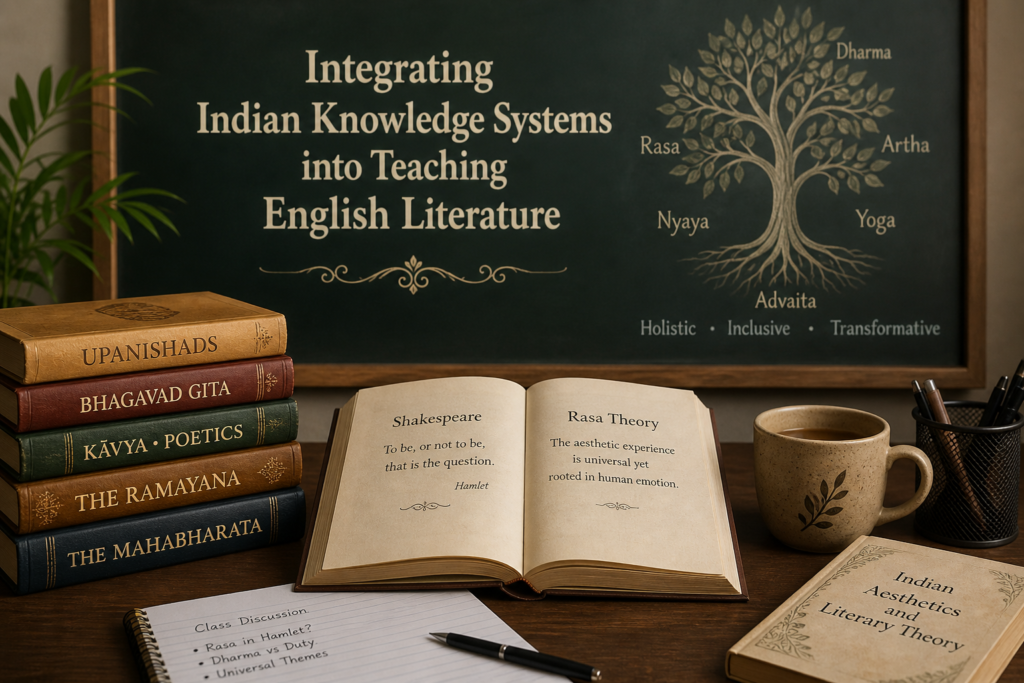
Introduction: Why Indian Knowledge Systems Matter in Contemporary Literary Pedagogy
The integration of Indian Knowledge Systems in English Literature teaching has emerged as one of the most consequential pedagogical imperatives of our time. Across Indian universities, a quiet but profound transformation is underway—one that challenges the long-standing dominance of Eurocentric frameworks in the study of literary texts. This shift is not merely reactive or nationalistic; it is epistemologically necessary. As the National Education Policy 2020 (NEP 2020) formally mandates the inclusion of Indian Knowledge Systems across disciplines, English departments find themselves at a particularly productive crossroads: how does one honour the richness of the English literary canon while simultaneously grounding students in the philosophical and aesthetic traditions that have shaped Indian civilisation for millennia?
The gap, frankly, remains wide. Walk into most undergraduate English classrooms today, and you will encounter Aristotle’s Poetics, Northrop Frye’s archetypal criticism, and Terry Eagleton’s Marxist literary theory—but rarely Bharata’s Natyashastra, Anandavardhana’s Dhvanyaloka, or the epistemological frameworks of Nyaya and Advaita Vedanta. This article argues that Indian Knowledge Systems can powerfully enrich literary interpretation, deepen pedagogical practice, and expand the epistemological vocabulary available to both teachers and students of English literature.
Understanding Indian Knowledge Systems (IKS): A Conceptual Overview
What Constitutes IKS?
Indian Knowledge Systems encompass a vast and sophisticated body of intellectual traditions that predate—and in many cases parallel—the foundational texts of Western philosophy and literary theory. At the philosophical level, they include the Vedantic schools (particularly Advaita, Vishishtadvaita, and Dvaita), the Nyaya school of logical epistemology, and the profound analytical traditions of Buddhist philosophy, particularly Pramana theory. Each of these offers a rigorous and internally consistent approach to questions of knowledge, reality, language, and perception.
At the literary and aesthetic level, IKS encompasses the Itihasa tradition (the Mahabharata and Ramayana as narrative epistemologies), the Puranic tradition, and the classical poetics articulated in works such as the Natyashastra (circa 200 BCE–200 CE) and the Dhvanyaloka (9th century CE). What distinguishes IKS most fundamentally is its holistic character: ethics, aesthetics, spirituality, and epistemology are not compartmentalised into separate disciplines but understood as deeply interpenetrating dimensions of human experience.
IKS vs Western Literary Theories
It would be intellectually reductive to position IKS in simple opposition to Western literary theory. Structuralism, post-structuralism, Marxist criticism, and psychoanalytic approaches each offer valuable analytical tools; the project of integrating IKS is not one of replacement but of complementarity. Consider, for instance, the relationship between Rasa Theory—the aesthetics of affective response articulated by Bharata in the Natyashastra and later elaborated by Abhinavagupta—and Reader-Response Theory as developed by Hans Robert Jauss and Wolfgang Iser.
Both traditions foreground the role of the audience in the production of aesthetic meaning. Yet where Iser speaks of ‘implied readers’ filling textual ‘gaps,’ Abhinavagupta’s concept of Sahridaya—the emotionally attuned, culturally prepared spectator or reader—posits a far richer phenomenology of aesthetic reception. Rather than a passive model of gap-filling, Rasa theory describes an active, even transcendental, process of aesthetic experience (Rasasvada) that transforms the reader. This is not a contradiction of reader-response theory; it is its philosophical deepening.
Why Integrate IKS into English Literature Teaching?
Decolonizing the Curriculum
The global conversation around decolonising the humanities curriculum—powerfully advanced by scholars such as Ngugi wa Thiong’o, Gayatri Chakravorty Spivak, and Homi K. Bhabha—has made it intellectually untenable to continue treating the Western literary tradition as the universal standard against which all others are measured. For Indian students, who have grown up within knowledge cultures shaped by Sanskrit poetics, devotional literature, and philosophical debate, Eurocentric pedagogy creates a peculiar kind of cognitive dissonance: they are taught to analyse texts through frameworks that implicitly marginalise their own epistemic inheritance.
Integrating Indian Knowledge Systems in English Literature teaching is, therefore, an act of curricular justice—not a concession to populism, but a correction of a historical imbalance that has impoverished literary education in India for over a century.
Enhancing Critical Thinking Through Multiple Epistemologies
When students are equipped with multiple interpretive frameworks—Western and Indian, ancient and contemporary—they develop a significantly more flexible and rigorous critical intelligence. A student who can read a text through the lens of both Marxist ideology critique and the ethical framework of Dharma, or who can analyse poetic ambiguity through both New Criticism’s ‘irony’ and Dhvani theory’s ‘resonance’ (vyanjana), is a demonstrably more sophisticated reader. Multiplicity of frameworks does not produce confusion; it produces discernment.
Aligning with National Academic Priorities
The NEP 2020 has created both an institutional mandate and a genuine opportunity for curriculum reform. Universities seeking NAAC accreditation and academic relevance are increasingly expected to demonstrate meaningful integration of IKS across disciplines. For English departments, this is not a bureaucratic burden but an invitation to genuine intellectual renewal—to design curricula that speak to the lived epistemic reality of their students while maintaining the rigorous scholarly standards that the discipline demands.
Best Ways to Integrate IKS into English Literature Classrooms
1. Use Rasa Theory to Analyze Emotional Structures in Literary Texts
Bharata’s Rasa Theory identifies nine fundamental emotional essences (Navarasa)—Shringara (love), Hasya (comedy), Karuna (pathos), Raudra (fury), Vira (heroism), Bhayanaka (terror), Bibhatsa (disgust), Adbhuta (wonder), and Shanta (tranquillity)—as the aesthetic building blocks of all great literature. This framework offers a remarkably productive tool for analysing the emotional architecture of canonical texts.
Take King Lear. Where a conventional reading might focus on themes of power and familial betrayal, a Rasa-informed reading charts the text’s movement from Shringara (the father’s love for his daughters) through Raudra and Bhayanaka, arriving finally—and devastatingly—at Karuna, the dominant rasa of the tragedy. A classroom activity could ask students to map the dominant and subsidiary rasas across scenes, discussing how Shakespeare orchestrates emotional transitions. The comparative insight is revelatory: Aristotle’s catharsis describes the purgation of emotion; Rasa theory describes its aesthetic transformation and transcendence.
2. Introduce Dhvani Theory for Deeper Textual Interpretation
Anandavardhana’s Dhvani theory—the aesthetic of poetic ‘resonance’ or ‘suggestion’—argues that the highest poetry communicates not through denotative or even connotative meaning, but through a third, deeper level: dhvani or vyanjana, the suggestive power of language that speaks beyond what is literally or figuratively stated. This is, in effect, a sophisticated Indian theory of poetic subtext.
When teaching T.S. Eliot’s The Waste Land, Dhvani theory becomes an extraordinarily useful instrument. Students trained in the concept of dhvani are sensitised to the way Eliot’s fragmentary images—the Thames daughters, the typist’s encounter, the Fisher King—resonate beyond their surface meaning, creating a layered field of suggestion that no paraphrase can exhaust. Where Western criticism speaks of ‘ambiguity’ (Empson) or ‘the objective correlative,’ Dhvani theory provides a philosophically grounded account of why and how this suggestive power operates.
3. Use Itihasa-Purana Narratives for Comparative Literature Approaches
The Mahabharata and Ramayana are not mythological curiosities; they are among the most complex and philosophically sophisticated narratives in world literature. Integrating them into comparative literature modules opens extraordinarily rich pedagogical territory. The figure of Arjuna in the Mahabharata—paralysed before the battlefield by a crisis of dharma and identity—offers a fascinating counterpoint to the Homeric hero Achilles, whose crisis is one of honour and rage.
More profound still is the comparative study of the concept of dharma versus Western individualism. Where Homeric and later existentialist heroes are primarily oriented toward the assertion of the autonomous self, the dharmic framework of the Itihasa tradition situates human action within a web of relational, cosmic, and ethical obligations. This is not a lesser philosophical position; it is a different and equally serious one—and it challenges students to interrogate assumptions they have never previously needed to examine.
4. Incorporate Indian Philosophical Concepts into Literary Theory Discussions
The philosophical concepts of Dharma, Karma, and Advaita Vedanta can be productively introduced into literary theory seminars, particularly when students are engaging with existentialist literature. Jean-Paul Sartre’s foundational claim—that existence precedes essence, that the human being is radically free and therefore radically responsible—creates a productive philosophical tension when read alongside the Advaitic concept of Brahman as the non-dual ground of all being.
Where Sartre locates the individual in a condition of anguished freedom before an indifferent universe, Advaita Vedanta posits that the apparent separateness of the individual self (jiva) from the cosmic whole (Brahman) is itself a form of avidya—ignorance or spiritual illusion. Both traditions are deeply serious about human freedom and responsibility; but they arrive at radically different conclusions about the nature of the self that exercises that freedom. Reading Sartre’s Nausea or No Exit alongside selections from the Mandukya Upanishad and Shankara’s Vivekachudamani transforms a theory seminar into a genuinely cross-cultural philosophical dialogue.
5. Design Interdisciplinary Assignments Based on IKS
Assessment design is where pedagogical intention becomes pedagogical practice. Assignments that require students to compare Rasa Theory with contemporary Affect Theory (as theorised by Brian Massumi or Sara Ahmed) encourage genuinely original research, since the field remains largely unexplored. Similarly, asking students to apply the Nyaya school’s rigorous framework of logical inference (Anumana) to the construction of argumentative academic essays produces a metacognitive awareness of reasoning structures that conventional essay training rarely achieves.
Such interdisciplinary assignments also prepare students for research careers at the frontier of comparative literary studies—an area of growing international academic interest—and position them as contributors to emerging scholarly conversations rather than mere inheritors of established ones.
6. Use Regional Literature and Vernacular Texts in Translation
No programme of Indian Knowledge Systems in English Literature teaching is complete without sustained engagement with the great writers of the regional and vernacular traditions. Munshi Premchand’s fiction—particularly Godaan and stories such as Kafan—brings the sociological and ethical complexity of rural Indian life into direct literary conversation with the European realist tradition. Rabindranath Tagore, whose Nobel Prize in Literature (1913) was the first awarded to an Asian writer, demonstrates with supreme artistic authority that Indian narrative and poetic forms are not provincial alternatives to Western literary achievement but genuinely universal contributions to world literature.
Including such texts in translation builds the cultural context essential for meaningful literary analysis while simultaneously challenging the implicit hierarchy that treats English-language texts as the norm and vernacular literatures as supplementary.
Challenges in Integrating IKS—and How to Overcome Them
Limited Faculty Training
Many English faculty members, trained exclusively in Western literary theory, lack familiarity with Sanskrit poetics or Indian philosophical traditions. The solution is structural: universities must invest in faculty development programmes—short-term workshops, collaborative seminars with Philosophy and Sanskrit departments, and curated reading series—to build the interdisciplinary competence that IKS integration requires.
Lack of Structured Curriculum Material
There is currently a shortage of well-designed, pedagogically appropriate teaching materials that present IKS concepts in accessible form for undergraduate English students. Departments should collaborate to develop curated reading lists, annotated anthologies, and open-access teaching modules—and should look to institutions such as the Rashtriya Sanskrit Sansthan and the Indian Institute of Advanced Study for partnership opportunities.
Student Resistance or Lack of Familiarity
Students accustomed to Western frameworks may initially resist the unfamiliar terrain of IKS concepts. The pedagogical solution is scaffolding: begin with relatable contemporary examples (the emotional grammar of Bollywood cinema, for instance, is deeply structured by Rasa aesthetics), establish experiential familiarity, and then introduce the theoretical framework. Resistance typically dissolves when students discover that these concepts illuminate their own aesthetic experiences with new precision.
Practical Classroom Model: A Sample Lesson Plan Integrating IKS
Topic: King Lear and Rasa Theory (90-minute seminar)
Step 1 — Concept Introduction (20 min): Introduce the Navarasa with examples from familiar popular culture. Explain Bharata’s principle that great art orchestrates emotion rather than merely expressing it.
Step 2 — Textual Application (25 min): Students read Act IV, Scene VII of King Lear (Lear’s reunion with Cordelia) and identify the dominant and secondary rasas at work.
Step 3 — Group Discussion (20 min): How does Karuna operate differently in Bharata’s framework versus Aristotle’s catharsis? What does Rasa theory illuminate that Aristotle does not—and vice versa?
Step 4 — Reflective Writing (25 min): Students write a 300-word critical response exploring how Rasa theory changes their reading of a scene of their choice.
Outcome: Students leave the seminar with a demonstrably richer interpretive vocabulary and a first-hand understanding of how IKS frameworks generate genuine critical insight rather than merely decorative cultural reference.
SEO and Academic Benefits of Integrating IKS in Literary Studies
From a scholarly and research perspective, integrating Indian Knowledge Systems in English Literature teaching generates significant academic dividends. Research articles that employ IKS frameworks in literary analysis occupy a relatively sparse field, meaning that scholars who work in this area can establish intellectual priority in a domain of rapidly growing interest. Journals in comparative literature, postcolonial studies, and world literature are increasingly receptive to work that brings non-Western theoretical frameworks into substantive dialogue with canonical texts—not as an exercise in cultural relativism, but as a contribution to genuinely pluralistic literary scholarship.
For educators and curriculum designers, alignment with IKS also responds to accreditation frameworks that increasingly reward interdisciplinary and culturally inclusive pedagogical design.
Conclusion: Toward a Pluralistic and Contextual Literary Pedagogy
The integration of Indian Knowledge Systems into English Literature pedagogy is neither a nationalist gesture nor a repudiation of the Western intellectual tradition. It is, rather, an act of epistemological maturity—the recognition that human beings have generated multiple, equally serious, and often complementary frameworks for understanding language, beauty, meaning, and ethical life. The Rasa theorist and the reader-response critic, the Advaita philosopher and the existentialist, are not opponents; they are interlocutors in a conversation that has barely begun.
For English departments across India, the path forward lies in the deliberate and rigorous construction of hybrid theoretical frameworks—pedagogical structures that hold Western and Indian traditions in productive tension, allowing each to illuminate what the other cannot fully see. This is not the easier path; it demands broader preparation, more ambitious curriculum design, and a genuine willingness to unsettle familiar hierarchies of knowledge. But it is the path most worthy of a great university—and most just to the students who trust us with their intellectual formation.
Keywords: Indian Knowledge Systems in English Literature teaching, Rasa Theory, Dhvani Theory, Decolonizing Curriculum, NEP 2020, Comparative Literature, Advaita, IKS Pedagogy
About Dr. Bhanumati Mishra Dr. Bhanumati Mishra is the Head of the Department of English at Arya Mahila Post Graduate College (AMPGC), Banaras Hindu University (BHU). Her work focuses on the intersection of Postmodern theory, gender studies, and the integration of Indian Knowledge Systems (IKS) into modern academic frameworks.
Visit the Main Portal for more research and academic resources.